
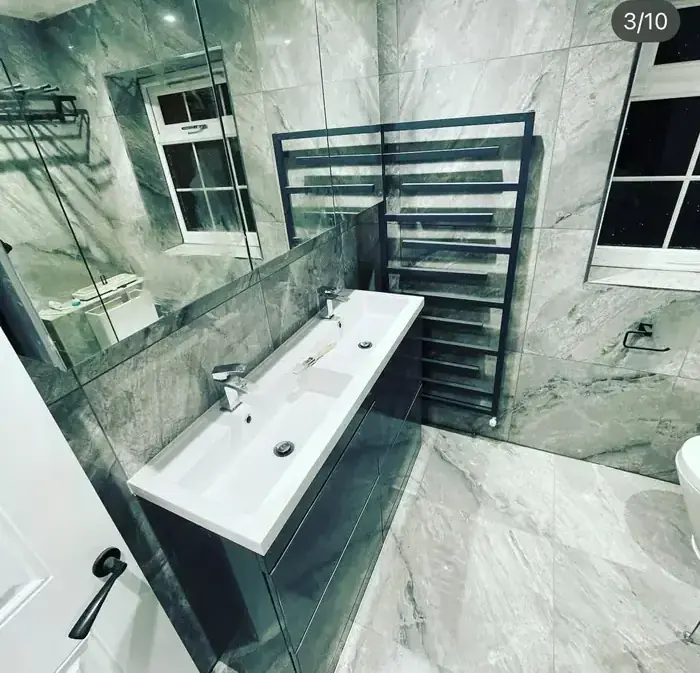
How a Great Dunmow bathroom refit actually runs
One team, one job, start to finish. Day one is protection and strip-out — floors covered, suite out, tiles off, skip on the drive or a permit arranged if there is no off-street parking. Days two and three are first fix: pipework rerouted, wastes reset to fall, noggins doubled behind the basin, rail, WC frame and any future grab rail. Then boarding and tanking, tiling, second fix, silicone, and a snagging walk-round with you before the final payment. Most Great Dunmow bathrooms are done in 8 to 12 working days and you are never left wondering who is turning up tomorrow.
Tanking in Great Dunmow's older cottages and barn conversions
A good number of CM6 bathrooms are in listed cottages off the High Street or in converted outbuildings, where walls are lime-plastered, out of plumb and never dry in the way a modern stud wall is. Sealing those with a plastic membrane traps moisture and blows the plaster within a season. We use a vapour-permeable build-up on solid walls, cement board and taped slurry on any new stud, and keep the shower zone on the newer fabric wherever the layout allows. Everything is pressure tested before it is closed up.
Floors, falls and level access
Timber floors get overboarded and stiffened before tiling, because a floor that flexes cracks grout no matter how good the tiler is. Wet rooms get a recessed former between the joists so the finished floor is genuinely level with the landing, with the fall formed into the former rather than built up in adhesive, and a linear drain positioned so the shower screen sits on a flat line.
New-build estates on the Woodside and Chelmsford Road edge of town
The newer estates around the Woodside and Chelmsford Road side of Great Dunmow have plasterboard-on-dab walls, shallow floating floor zones and combi pressures that vary by plot. Fixings for a wall-hung WC frame or a rail go into doubled noggins, never plugs; underfloor heating goes over an isolating layer so the screed does not telegraph; and we flow test the main before a rainfall head is specified, rather than fitting one and hoping. If the pressure is not there we say so at survey and price a pump.
One team, one continuous block
Great Dunmow is around half an hour east of our base, so we book CM6 work as a single consecutive-day block with the materials delivered up front. That way the job runs eight to twelve straight days rather than being stretched around travelling, and you know which two faces are turning up each morning.

